Published by The Daily Mail (23rd March, 2026)
Joe was busy mending nets as he explained why he had stopped going out in the brightly-painted canoes. We were sitting on Jamestown beach, which is overlooked by its iconic colonial fort and lighthouse in the Ghanaian capital of Accra.
‘There used to be fish in abundance, so we did not need to go a long distance,’ he told me. ‘You knew that when you went out, you get the money. You spend it. Then tomorrow you can go and get more fish – the sea was almost like a bank.’
Now everything has changed. The fishermen have to head out further into the waters of the Gulf of Guinea – and when they do, their haul is often worthless.
‘You pull the net and it is heavy so you think you have a lot of fish – but when it comes up you see a lot of this rubbish, the clothes, mixed up with maybe small fish,’ added Joe, 63. ‘So you don’t get a lot of catch nowadays, even if you go far.’
Piles of clothes studded the beach – despite a weekly clean-up three days earlier by volunteers that removed 28 tonnes of textiles and plastics. In areas the team had not reached, the sand was buried beneath a thick crust of soggy and rotting cast-offs, while the waves pounding the shore were filled also with this putrid clothing waste.
I saw bras, pants, T-shirts, jeans, shoes, handbags. Many had familiar labels. A pair of yellow Tommy Hilfiger shorts were held up by Bright Ayikpah, 29, a local activist with Tide Turners which organises the clean-up efforts.
‘Watching these tides of waste drown our shores is a nightmare no community should wake up to; it erodes the beauty of our surroundings,’ he said sadly.
And the biggest source of these discarded clothes? Britain.
Despite the best intentions of well-meaning citizens who take unwanted garments to charity shops or donation bins, vast quantities of the items they donate end up here, as rubbish, rather than being sold on as many of us expect.
The British clothes polluting the shoreline and the sea around me are mostly second-hand and often from the charity sector, along with items collected by local authorities and retailers through return schemes and commercial operations.
Only about one-third of clothes donated to charity shops are actually bought by customers. Most of what remains is sold to export businesses, then sent to markets overseas – in particular to Ghana, which is home to the world’s biggest second-hand clothing market here in Accra.
Sprawling Kantamanto Market employs 26,000 people, imports about 15million garments a week and serves a thriving domestic trade as well as neighbouring countries.
I watched traders there open bales from Britain crammed with clothes from almost all our best-known High-Street stores. Some still had their tags from retailers and charity shops, displaying old prices and hefty discounts.
But approaching half of them are unsellable – so, every day, an estimated 900,000 items of clothing are thrown away in this developing West African nation whose overloaded and struggling waste management systems cannot possibly cope.
So the clothes clog drains and waterways that flow into the sea. They damage delta wetlands protected for rare birds and endangered turtles. And they contaminate the air and water with microplastics due to the growing use of synthetic materials in clothing.
The foul mess is the costly legacy of a global fast-fashion industry that produces far more garments than any of us need.
It not only exposes the dismal failure of the industry’s recycling efforts but also the disgraceful hypocrisy of charities that are only too happy to allow our cast-off clothes to be dumped indiscriminately in Africa.
And it has created an appalling environmental crisis in Ghana.
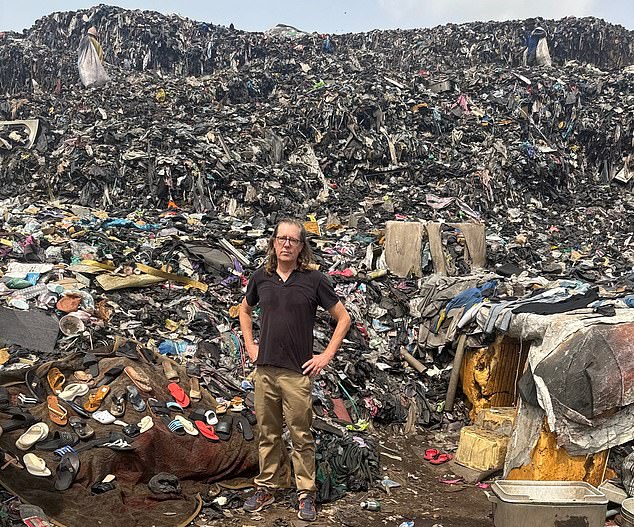
Not far from the beach is Accra’s grotesque monument to this globalised culture of greed and waste – a massive mountain of textile waste and stinking trash that towers about 60ft over the Odaw River beside homes in Old Fadama, a huge informal slum-like settlement branded ‘Sodom and Gomorrah’ by Ghanaian politicians.
I climbed this fetid mound, sweating in the heat as I passed local people searching for plastic bottles to sell. We stood on sandals, pink underwear, trousers, football shirts and mounds of other garments.
At the top, I looked out at smoke rising over the river from a notorious dump of electronic waste, much of which originates also in Europe and North America.
I walked on to the beach, passing children playing and goats foraging amid homes built on rubbish. There was the surreal sight of a man effectively walking on water since the river – which feeds a picturesque coastal lagoon and the sea – is so stuffed with clothing and plastic.
‘There is nowhere to hide waste here, unlike in the UK or US where it can be easily hidden in sanitary landfills or incinerated, so it just gets dumped or burned,’ said Liz Ricketts, co-founder of The Or Foundation, which campaigns against textile waste.
Ricketts, 39, started work as a stylist in New York’s fashion world just as the sector exploded in size, with soaring output and ultra-fast product cycles that enable retailers such as China’s Shein to churn out 10,000 new designs a day at rock-bottom prices.
Clothing production doubled over the first 15 years of this century and has shown no signs of slowing down. But while shoppers buy far more garments – with Britons among the world’s keenest shoppers – their purchases often get worn less. Cheap clothing has become a disposable product.
Ricketts moved to Ghana in 2011 to ‘upcycle’ discarded garments with a fairtrade fashion firm. She saw first-hand the environmental damage caused by fast fashion after glimpsing a pair of jeans ‘surfing’ in the waves and hearing a swelling chorus of complaints from Kantamanto traders about the rapidly declining quality of imports, even from established brands.
She started the Or Foundation with a partner, and it now employs 200 people to campaign against ‘waste colonialism’, support traders and help entrepreneurs find ways to use junked items.
‘The fast fashion model is a volume-over-values business. But it is not just about over-production. How can a product that sells for almost nothing ever be viable or sustainable in a resale market?’ asked Ricketts.
Her concerns were echoed by women traders in Kantamanto. ‘Look at this bale I just opened,’ said Mavis, 48, sorting through a mound of bras and placing dozens of them in her pile of discards. ‘You get 600 pieces but, nowadays, you throw away at least 200.’
This mother-of-six, a vendor at the market for almost two decades, said she paid 3,600 cedi (£251) for the bale but feared she would only earn 2,000 back (£139) selling her best bras for only 15 cedi (£1.05). ‘So many of them are torn or you pull the plastic and it is all worn out,’ she said.
Another woman had a huge pile of rejected white clothes, displaying labels such as George, New Look and Primark from her new bale. ‘Look at this one with the stain on the armpit,’ she said, waving a H&M top at me. ‘Who would want to buy this?’
Although this controversial trade in obroni wawu (‘dead white person’s clothes’) is banned in some African nations on the basis that it is undignified and undermines local textile businesses, it is claimed that 2.5 million Ghanaian jobs rely on this sector. Kantamanto Market – which suffered a devastating fire last year that left two people dead – was stiflingly hot. Most vendors hung or stacked their clothes neatly in their stalls, but the narrow walkways were strewn with waste items.
One vendor hung a T-shirt for Disneyland in California claiming to be ‘the happiest place on earth’ beside another saying ‘Let’s talk about socialism’ from Britain’s far-Left Socialist Workers Party.
Imported baby and children’s clothes are most prized since they sell well and are seen as most likely to arrive in decent condition.
In one workshop, I found women transforming adult items into smaller children’s sizes while, nearby, men ironed Premiership football team crests on to old T-shirts to try to boost prices.
Early on a Friday morning, I watched as a veteran trader opened a 55kg bale of cotton blouses from the UK that she had bought as ’top grade’ for 3,200 cedi (£223), hoping to find winning items for her weekend customers.
‘It’s like gambling – I know it is ladies’ tops but I don’t know what is inside,’ said Gifty, 56, as she cut bindings and removed plastic wrapping to investigate the squashed contents. ‘If it is fine, that is my good luck. But often you cut in and they are not fine.’
One striped blouse had a tag showing price cuts – from £19.50 to £4.29, and finally £1.89. It was from Marks & Spencer, the third most common brand after Adidas and Nike found among 1,500 tonnes of waste cleared from the beach over 12 months. These were followed by Next, Tommy Hilfiger, Primark, Puma and Zara.
Many other garments had price tags from charity shops such as Age UK Wyvern, Headway in Birmingham and Solihull, Nottinghamshire Hospice, Compton Care in the West Midlands and Priscilla Bacon, a Norfolk hospice. A blue Next top from East Anglia Children’s Hospice shop was thrown into the reject pile. ‘Look at it – it’s low quality and fading,’ said Gifty. ‘No one coming all the way from their house to buy clothes would want to buy something like this.’
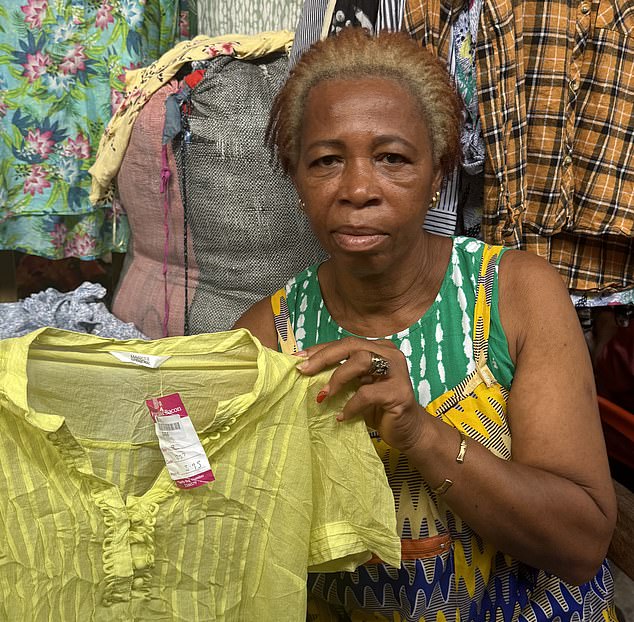
Trader Mary Sarkodie, 60, began visiting the market three decades ago with her step-mother. She also condemned plunging quality, even among top brands, and said many clothes arrived distressed, faded, ripped, stained – and even covered in blood. ‘I blame the importers first, the exporters second, then the fashion brands.
‘But I blame the charities too – they pick the better items to make money, then the ones deemed not nice enough, they say go give them to the Africans. They think we are sitting on trees, so anything goes for us. This is disrespectful. They just think about profits. They think we are lesser human beings and don’t know what is good. It makes me feel very bitter.’
Certainly the scale of waste is obscene. The head of Accra’s waste management said last year the city can only collect and process less than one-third of clothing debris leaving the market.
This followed a Greenpeace Africa investigation that found unofficial dumps cropping up in conservation areas such as Densu Delta wetlands, which supports rare birds and endangered turtles that use the beach to lay eggs.
Globally, only one per cent of clothing is recycled into new garments. But there are innovative efforts in Ghana to turn this tide of waste into everything from cool hats made from T-shirt yarn through to handbags, paper and even tiles for construction.
Among the most successful projects is The Revival, a non-profit group launched eight years ago by Yayra Agbofah, a former trader in the market, after he became infuriated by the waste and pollution.
‘We have to bear the cost of someone else’s waste. Our beaches are clogged with clothing, our air is polluted by open-air burning of things such as shoes – and none of it was worn by us.’
His organisation is ‘upcycling’ 2.3 million garments a year, including the production of £55 patchwork denim tote bags for the V&A Museum – and now plans to build a 100-tonne warehouse made with bricks from shredded clothes.
No one I spoke to in Ghana wanted to ban this trade that dates back to the colonial era: what they do want is for retailers to stop churning out shoddy, synthetic-filled products and for Westerners to appreciate how many of the items they donate to charity are simply shipped off and sold to Africa where they are discarded.
‘I urge people to be cautious about consumption since your choices – even in the UK – can have a ripple effect on someone, somewhere,’ said Agbofah. ‘And if you want to donate something, please make sure it is in a good enough condition to be worn. The recycling bin is not a trash can, the charity shop is not a dumping ground.’
Robin Osterley, chief executive of the Charity Retail Association, said no one wanted to see used clothing piled up on African beaches but it was wrong to blame UK charities, insisting they kept vast amounts of clothing out of incinerators and landfill. ‘Under no circumstances would charity shops deliberately export waste,’ he said.
Osterley argued that the issue had to be tackled at source with ‘radical change to reduce over-production of textiles’, with incentives to produce more durable garments and by forcing fashion brands to support waste management in places such as Ghana.
The UK Fashion and Textile Association, which represents the fashion industry, said that while it did not condone clothes dumping, the export of second-hand items to African nations such as Ghana had been a legitimate trade route for decades. Chief executive Adam Mansell said the growth of ultra-fast fashion had led to a significant increase in the volume of low-quality textiles on the global market.
‘The reuse and recycling sector, and retailers, are actively working to address these challenges and are calling on the Government to introduce legislation to support investment in national textile recycling infrastructure,’ he said.
In the meantime, fishermen like Joe will continue to suffer as their livelihoods are submerged under a tide of filthy fashion from the West.