Published by The Daily Mail (21st August, 2026)
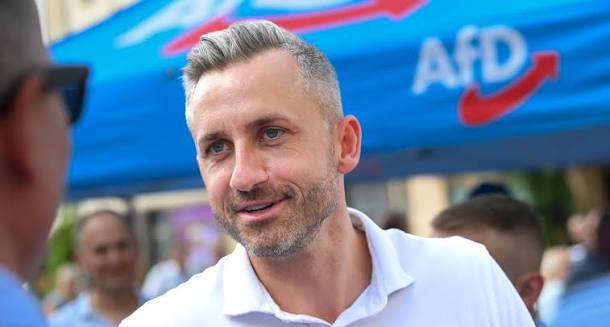
The scene in the village of Moeser seemed like a typical summer barbecue – except for the long line of people queuing to grab a selfie or autograph from a 35-year-old man in a white polo shirt under a blue awning.
It would be easy to assume he was a visiting film or pop star with his sharp haircut, friendly smile and beefy bodyguards as I watched him backslapping men, charming women and joking with excited children.
When he went up to the stage to give a short speech, there were loud cheers from the crowd, chants of his name and bursts of applause.
Yet he is a politician. His name is Ulrich Siegmund. And next month he might win power in the state of Saxony-anhalt, becoming the first far-right nationalist to run a state government in Germany since the Nazis rose to power in the 1930s.
His fans see him and his populist Alternative for Germany (AFD) party as saviours of their troubled nation. ‘We stand for freedom. We stand for once again standing up for our own country and our own people,’ he told me.
To many other citizens, however, Siegmund is a chilling reminder of the darkest days in their country’s history – and the federal government is taking urgent steps to ensure that his pro-russian party cannot undermine German security or thwart Nato defences.
There are fears that if international conflict erupts, a victorious AFD could block the transport of troops and weapons through the state – which sits in a pivotal position close to Berlin in the former East Germany – and that the party could abuse access to intelligence.
The day after I met Siegmund, the country’s leading news magazine Der Spiegel branded him ‘Germany’s most dangerous man’ on its cover, claiming that behind the glad-handing and smiles lies an extremist network that frightens even his own side.
Some residents are preparing to flee for other parts of Germany. Migrants fear they will be forced out. And the Protestant bishop in this small state where Martin Luther launched the Reformation five centuries ago is urging voters not to support him.
‘The Afd’s political position, based on its programme, cannot be reconciled with Christianity,’ said Friedrich Kramer, Regional Bishop of the Evangelical Church. ‘The AFD opens its door very widely towards the extreme Right. They speak of the Nazi era as a “speck of bird droppings” in German history.’
Germany – like many countries in Europe – has seen populism surge on both Left and Right amid rapid economic, social and technological turmoil.
Until now, however, the AFD has been blocked from power by other parties forming coalitions to build a brandmauer, or firewall, around them. The AFD won in neighbouring Thuringia two years ago – gaining 32 per cent of the vote and coming nine points ahead of its closest rival – only to be kept out of office after three Left and Right-wing parties joined forces.
But on September 6, Saxony-anhalt votes in a potentially seismic election, with the two most recent polls putting the AFD on 42 and 43 per cent. This suggests it could secure an absolute majority, that no firewall would work and it could take office for the first time.
‘Saxony-anhalt is only the first step,’ Siegmund told me. ‘We want to achieve this throughout the country. In the coming years, I see more states led by the AFD and then – by 2029 at the latest – we will be in Berlin.’
Given the Afd’s widening lead in national polls, this is not an outlandish prediction – and supporters are flocking to the state to aid Siegmund’s march to power. ‘It starts here and from here it goes on, and everything is possible,’ declares his campaign song.
This party’s soaring popularity comes despite the fact that Germany’s Office for Protection of the Constitution – the domestic intelligence agency – last year formally designated the AFD as an ‘extremist entity’ after a three-year inquiry, permitting it to intensify surveillance of the party and sparking calls for a ban.
‘If you have cancer and 42 per cent of your body is full of cancer, do you give up the body or do you try to contain the cancer?’ replied one prominent MP in Berlin when I questioned the wisdom of outlawing a popular political party in a democracy.
This pivotal election comes just 13 years after the party was launched to oppose German-funded European Union bailouts under former chancellor Angela Merkel.
The Afd’s popularity – and radicalism – grew after the 2015 migration crisis, when Merkel opened the borders to at least one million migrants and refugees in response to the war in Syria. Some leading figures even started to echo Nazi slogans and call for Germany to downplay Nazi crimes.
‘We Germans, our people, are the only people in the world who have planted a monument of shame in the heart of their capital,’ said Bjoern Hoecke, a firebrand AFD leader, referring to the Holocaust memorial in Berlin.
Siegmund was among hardliners reported to have participated in a secret meeting three years ago to discuss a remigration ‘masterplan’ with mass deportations of asylum seekers and ‘non-assimilated’ citizens. He called for his home state to become ‘as unattractive as possible’ to those being targeted, suggesting even ‘foreign restaurants should be put under pressure’.
Now this slick campaigner – who has more than half a million Instagram followers and insists ‘Germany must become more German again’ – might be just days away from running Saxony-Anhalt, to the delight of those attending the Moeser barbecue.
‘I don’t see any far-right extremists here, just people from the middle – and if you want to argue the toss, I feel more threatened by Left-wing and Green extremists than I do from the Right,’ said Anna, an office worker attending with her mother.
Jenny Guettler, 30, standing beside her two sons, said the AFD was the only party that saw the scale of their problem with immigration. ‘People who are dangerous, who cannot afford to be here, they should go,’ she said bluntly.
The state capital of Magdeburg – eight miles from this AFD campaign event – was the scene of a terrible terror attack two years ago when a Saudi refugee drove a car into a Christmas market, killing six and injuring 299 people.
The murderer was not an Islamist, however, but a psychia-explained trist helping people to flee religious persecution. Many of its supporters link migration with crime. ‘I feel unsafe as a woman,’ said Guettler.
‘Since 2016 you get catcalls, you get looked at, you even get touched. Yes, that was my first memory of immigration in 2016. It felt so alienating.’
Peter Pavelzeck, 68, a retired mechanic, was wearing a shirt emblazoned with the flag of the former East Germany. He how he served as a young man in the Communist regime’s army – then told me he felt the big issue was peace and the need to restore relations with Russia. He quoted a saying attributed to Germany’s 19th-century leader Otto von Bismarck that for peace to exist in Europe, the Russian Tsar must be at the table. ‘That’s how I see it with Vladimir Putin – he should not be excluded,’ said the pensioner.
Such attitudes alarm many mainstream politicians as their country rapidly rearms, especially after incidents such as the drone that was found heavily laden with explosives next to a Ukrainian cargo plane earlier this month at the airport in nearby Leipzig.
The AFD wants Germany to lift sanctions on Russia, restore Russian energy links and end the arms flow to Ukraine – a move that would severely wound Kyiv since Berlin has become its biggest supplier of weapons. Its Saxony-anhalt platform seeks to restore Russian-language lessons in schools. The party’s deputy leader, an ideologue reportedly lined up to be education minister, has defended Putin’s invasion of Ukraine and travelled to Russia to wave the AFD flag in protest against Western values.
No wonder Moscow’s propaganda and disinformation machine is inflaming the AFD cause – especially given that Siegmund has said he might abolish the state intelligence agency.
Since Germany’s 16 states run their own police and local intelligence services – a post-nazi safeguard designed to thwart another Gestapo – there are concerns the AFD might prevent Nato troops crossing its terrain in a war or that the party could leak critical information.
Roderich Kiesewetter, an MP with the ruling Christian Democratic Union party and former army colonel, said the federal government was discussing how to get around this in the event of a crisis and override a state’s jurisdiction if the AFD took actions such as, for example, blocking railways to stop the transport of Nato troops. ‘In the case of a state of emergency or the Bundestag invoking of zustimmungsfall [emergency crisis laws] to guard against threats, federal police could then take over certain responsibilities. This is possible. It has never been exercised or practised but the Interior Ministry is now thinking about it,’ he said.
‘The AFD is offering to repeat the historic mistakes of the past… they tend to accept Russia as a leading power while regarding France, Britain and even the United States as decadent powers.’
Behind the rise of the AFD lies the shadow of German reunification in 1990. There was massive disruption across the former East German regions after much of its industry collapsed along with the Communist regime, leading to the perception that the region had been neglected by a political establishment largely rooted in the West.
Saxony-Anhalt, which was formerly in East Germany, has lost a quarter of its population since reunification – and those who left to build new lives in the West were often young, well educated and female. Now the state is the nation’s oldest demographically – and it has the biggest gender imbalance among 18 to 29-yearolds, with 121 young men for every 100 young women.
‘Reunification was more of a takeover by the West. This led to the feeling of being treated as second-class citizens. That feeling has lasted until today. Interestingly, it’s been passed down through the generations,’ said Kerstin Volkl, a political scientist at Martin Luther University in Halle who studies AFD voters.
Volkl believes this mood of resentment fuels extremism. She showed me data suggesting that support for dictatorship and for ‘trivialisation’ of Nazi-era crimes are strongest in this state. More than one in ten voters approve of the idea of dictatorship.
‘The AFD has become increasingly radicalised, particularly in Saxony-anhalt,’ she said. ‘Ulrich Siegmund is their friendly face. He’s extremely good rhetorically. He’s charismatic. He’s the figurehead for the AFD. The hardliners are in the background.’
The prospect of this ultranationalist party taking power – overseeing universities and schools along with arts, police and public broadcasting – scares many voters in the state that I met last week.
Speaking to two elderly women eating ice creams on a bench in Magdeburg, I asked for their views on the AFD. One shot back that she wants the party eliminated. ‘Weg, weg [Gone, gone],’ said Karen, 75, with an angry wave of her hand. ‘They have Nazis in their ranks and that is not acceptable at all. We have had all that before. History is repeating itself.’
Even some people who worry about immigration levels admitted to alarm. ‘I would not vote for the AFD out of a deep-rooted sense of fear,’ said Birgit, 55, a physiotherapist.
‘You don’t know how they will turn out but there is a fear they will be far too radical. When it comes to policy on migration, foreigners who have built lives here may be forced to leave. But at the same time, there is too much migration. So you feel torn between two extremes.’
Others worry their own lives may be uprooted. ‘My father is from Russia. I grew up here, this is my home, but in their eyes I am seen as different,’ said Leon Sokolov, 20, an aerospace engineering student. ‘They just want to make lives more difficult for people with a migration background. Maybe in the end it will be fine.
They cannot do that much at state level to throw people out. But if they won nationally, there would be a lot more problems since economically they want to exit the EU and remigrate people.’
Mohammed, 24, an asylum seeker from Iran, is leaving for the west of the country next month. ‘It is because of the situation here,’ he said. ‘There are many good things in Germany – I can find a job, I can study, transport is good – but sometimes in Saxony-anhalt, bad things happen.’
Like others I spoke to, he told of suffering racist abuse in shops and trams.
A German-born medical student, whose parents are from Nigeria, said he had faced a lot of hostility, including being called the N-word in hospital and when using public transport. ‘When it happens to me now I just laugh,’ said David Ojo, 24. ‘The problem is the AFD normalises hostility.
‘It legitimises the ideology that immigrants are the problem. I worry a lot about that. You go to the hospital here and the hospital does not work without immigrants at every level.’
Yet the discontent felt by many Germans runs far deeper than just over migration. A study by the State Agency for Political Education – a national body for the promotion of democracy – found migration ranks first among concerns for AFD supporters but only fifth for all voters after schools, jobs, cost of living and transport.
‘People want something different without necessarily knowing exactly what they want to be different,’ said the director Maik Reichel, a former Social Democratic MP. ‘If you ask them what should change, they say ‘everything.’
He argues that – as in the 1930s – people have lost a belief in aufsteigsvarsprechen, the traditional promise that the next generation will be better off. So they are falling for ‘messianic figures’ promising drastic change for the nation and a sense of hope.
Some experts suggest the AFD needs to be tested by a period of being in power, although Reichel fears they could make huge changes to the arts, education and society over five years in government. ‘Who wants to be the guinea pig in that situation?’ he asked plaintively.
The voters in this state may soon answer his question if they hand power to the AFD.